
Singapore Maths is a way of teaching primary mathematics that helps children understand why a method works, not just how to follow it. Children start with real objects, move on to pictures and diagrams, and only then work with numbers and symbols. This guide explains the main ideas behind the approach, with a simple example for each, so that parents and teachers can support children from Primary 1 (Grade 1) to Primary 6 (Grade 6).
What Singapore Maths Means
“Singapore Maths” describes the approach used in Singapore’s primary schools and in textbooks built on its national curriculum. In the early 1980s, Singapore’s Curriculum Development Institute began writing its own primary mathematics textbooks, with a strong focus on problem solving and thinking skills. The name “Singapore Maths” was later used in other countries to describe teaching based on those books.
The approach drew wider attention because of Singapore’s results in international studies. In TIMSS 2023, Singapore’s Secondary 2 pupils did better than their peers in all participating education systems, according to Singapore’s Ministry of Education.
At its heart, Singapore Maths aims to build confident problem solvers. Problem solving sits at the centre of the national mathematics framework, supported by concepts, skills, thinking processes, attitudes and the habit of reflecting on one’s own thinking.
The CPA Approach: Concrete, Pictorial, Abstract
CPA stands for Concrete, Pictorial, Abstract. It draws on the work of the American psychologist Jerome Bruner, who described how we learn by moving from handling objects, to images, to symbols.
- Concrete: children handle real objects, such as counters, cubes or coins.
- Pictorial: they draw, or look at, pictures and diagrams that stand for the objects.
- Abstract: they write a number sentence using numbers and symbols.
Example, Primary 2 (Grade 2): Share 12 strawberries equally among 3 children. How many strawberries does each child get?
- Concrete: the child deals 12 counters, one at a time, onto 3 plates until none are left, then counts 4 on each plate.
- Pictorial: the child draws 3 circles and shares 12 dots among them.
- Abstract: 12 ÷ 3 = 4. Each child gets 4 strawberries.
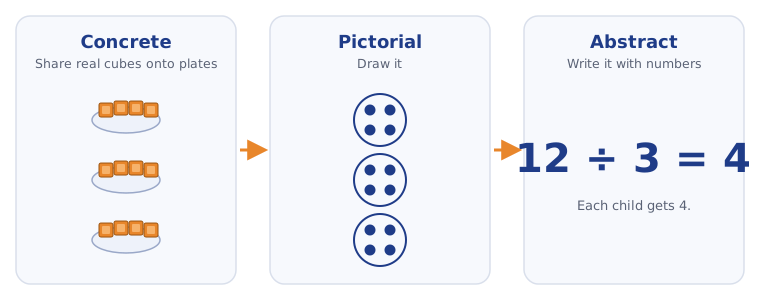
Children should not rush past the first two stages. A child who has shared real counters knows what 12 ÷ 3 means, and can check whether an answer makes sense.
Number Bonds
A number bond shows how a number is made up of two parts. The whole sits in one circle, joined to its two parts.
Example: 7 can be split into 4 and 3. This one bond gives four number facts: 4 + 3 = 7, 3 + 4 = 7, 7 − 4 = 3 and 7 − 3 = 4.
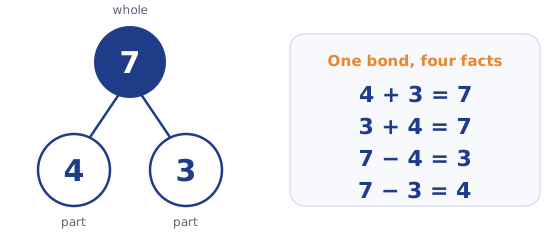
Number bonds to 10 are especially useful. To work out 8 + 5, a child splits 5 into 2 and 3, makes ten with 8 + 2 = 10, then adds the 3 to get 13. This “make ten” strategy is used again and again with larger numbers.
The Bar Model
A bar model uses rectangles to stand for the quantities in a word problem. It helps children see what they know, what they need to find, and which operation to use. Two common types are:
- Part-whole model: the parts make up a whole.
- Comparison model: two or more quantities are compared to find a difference.
Example, Primary 2: A class has 32 pupils. 18 of them are girls. How many boys are there?
Draw one bar for the 32 pupils. Mark one part as 18 girls and the other part as the unknown number of boys. Then 32 − 18 = 14, so there are 14 boys.
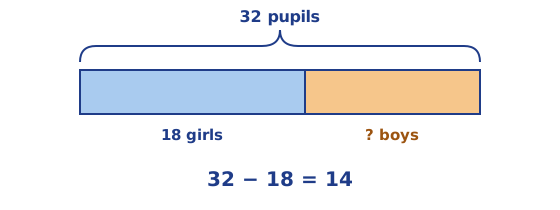
The same kind of drawing grows with the child. In upper primary, bar models are used for fractions, ratio and percentage. See our full bar model guide for more worked examples.
Mental Maths
Mental maths means working out answers in your head using number sense, rather than a written method. Singapore Maths teaches specific strategies, such as using place value, number bonds, and rounding a number and then adjusting.
Example: 98 + 37
- 98 is 2 less than 100.
- 100 + 37 = 137
- 137 − 2 = 135
Short, regular practice with strategies like this builds speed and flexibility. It also helps children estimate whether a written answer is reasonable.
Mastery: Fewer Topics, Deeper Understanding
Singapore Maths covers fewer topics in each year, but teaches each one in depth. Rather than meeting a topic briefly and moving on, children explore it with objects, pictures and symbols, practise it through varied questions, and apply it to problems. Topics come back in later years at a higher level, so new learning builds on secure foundations.
The aim is for every child to understand a concept well before moving on. This takes patience at the start, but it means less reteaching later and gives children the confidence to tackle unfamiliar problems.
Frequently Asked Questions
Is Singapore Maths only for children who are good at maths?
No. The step-by-step move from objects to pictures to symbols is designed to make ideas clear to all children. Children who find maths hard often benefit most from the concrete and pictorial stages.
My child's school teaches a different method. Will Singapore Maths confuse them?
The core ideas, such as number bonds and drawing a model, support most methods taught in school. Ask your child to explain how they reached an answer, and treat the bar model as a way to understand the question rather than a rule to follow.
Does my child have to draw a bar model for every question?
No. A bar model is a tool for understanding a problem. Once a child can see the structure of a question in their head, they may not need to draw it. For multi-step word problems, drawing the model is still a good habit.
Where should my child start?
Start at the level where your child can answer most questions confidently. Our Grade Levels guide shows how Singapore Primary levels compare with US grades and England years, and our free P1 to P6 worksheets are a quick way to check.