
Word problems are where children put their maths to work. This guide gives one complete worked example at each level, from Primary 1 (Grade 1) to Primary 6 (Grade 6), all taken from the Spartan Maths workbooks. Each example shows how a model makes the relationship between the quantities visible before any calculation starts. Work through an example with your child: read the problem together, let them draw the model, and use the prompt at the end of each example instead of giving the answer. These examples show selected skills only. They are not a full syllabus or a placement test. If the method itself is new to you, start with our Bar Model guide.
Primary 1 (Grade 1) Word Problem Example
Example title: Katrina’s beads
Topic: Addition within 20
Learning objective: Recognise a “putting together” story as addition and show it with a simple part-whole picture.
Problem
Katrina has 8 beads. Her sister gives her 6 more beads. How many beads does Katrina have altogether?
Question from Spartan Maths 1A.
Understand the problem
Katrina starts with 8 beads and gets 6 more. Both amounts are known. The total is unknown. The two groups join together, so this is a part-whole story.
Draw the model
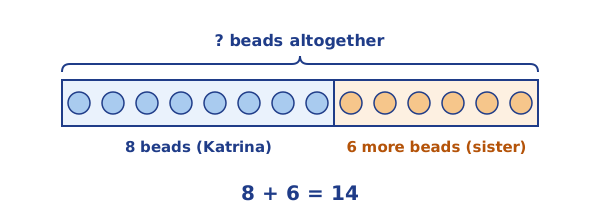
At this level, a picture of the beads works well. Draw 8 beads, then 6 more beads beside them, and put a bracket over all of them with a question mark.
Work it out
- The two parts join, so add: 8 + 6.
- Make 10 first: split 6 into 2 and 4. Then 8 + 2 = 10.
- 10 + 4 = 14
Answer
Katrina has 14 beads altogether.
Check
Take away the beads her sister gave her: 14 − 6 = 8, which is what Katrina had at the start.
A helpful prompt
“Is Katrina getting more beads or giving some away?”
Explore the Primary 1 programme.
Primary 2 (Grade 2) Word Problem Example
Example title: Bags of apples
Topic: Multiplication (equal groups)
Learning objective: See equal groups in a story and turn them into a multiplication.
Problem
Father buys 6 bags of apples. There are 5 apples in each bag. How many apples are there altogether?
Question from Spartan Maths 2A.
Understand the problem
There are 6 bags, and every bag holds the same number of apples, 5. The total number of apples is unknown. Equal groups point to multiplication.
Draw the model
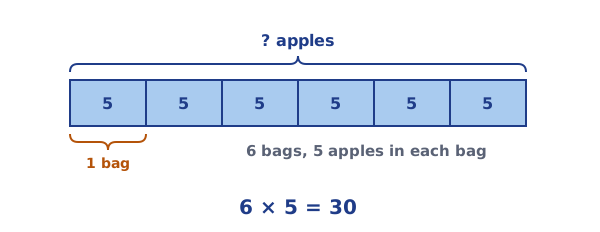
Draw one bar made of 6 equal units, one for each bag. Write 5 in every unit. Put a bracket over the whole bar with a question mark.
Work it out
- There are 6 groups of 5 apples.
- 6 × 5 = 30
Answer
There are 30 apples altogether.
Check
Count in fives along the bar: 5, 10, 15, 20, 25, 30. Or divide: 30 ÷ 6 = 5 apples in each bag.
A helpful prompt
“How many bags are there, and how many apples are in each one?”
Explore the Primary 2 programme.
Primary 3 (Grade 3) Word Problem Example
Example title: Three boys and $266
Topic: Multiplication and division, comparison model
Learning objective: Use one person’s amount as 1 unit to compare three quantities described with “more than” and “times as much”.
Problem
Dexter has $16 more than Edmund. Firas has 3 times as much money as Edmund. The three boys have $266 altogether. How much money does Firas have?
Question from Spartan Maths 3A.
Understand the problem
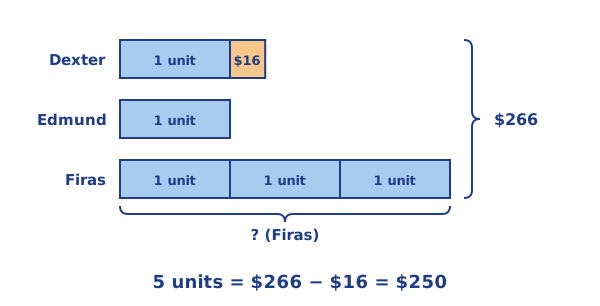
Both comparisons are made with Edmund, so Edmund’s amount is the natural 1 unit. Dexter has 1 unit and $16 more. Firas has 3 units. The total, $266, is known. Firas’s amount is unknown.
Draw the model
Draw Edmund’s bar as 1 unit. Draw Dexter’s bar as 1 unit plus a short extra piece labelled $16. Draw Firas’s bar as 3 units of the same size. Put a bracket beside all three bars labelled $266, and mark Firas’s bar with a question mark.
Work it out
- Take away Dexter’s extra piece so that only units are left: $266 − $16 = $250.
- Count the units: 1 + 1 + 3 = 5 units, so 5 units = $250.
- 1 unit = $250 ÷ 5 = $50
- Firas has 3 units: 3 × $50 = $150
Answer
Firas has $150.
Check
Edmund has $50, Dexter has $50 + $16 = $66 and Firas has $150. $50 + $66 + $150 = $266, and $150 is 3 times $50.
A helpful prompt
“Who is everyone being compared with? Can we make that person’s bar 1 unit?”
Explore the Primary 3 programme.
Primary 4 (Grade 4) Word Problem Example
Example title: Candies given away
Topic: Fraction of a set
Learning objective: Use equal units to find the part of a set that is left, without first working out the part given away.
Problem
A teacher had 72 candies. She gave away 7/9 of them to her students as rewards. How many candies did she have left?
Question from Spartan Maths 4A.
Understand the problem
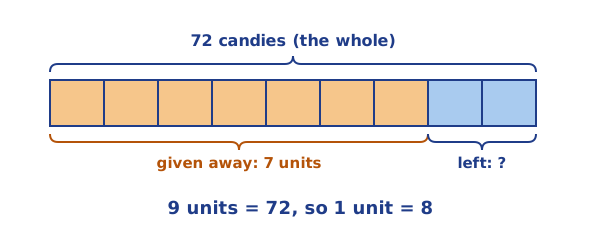
The whole set is 72 candies. The teacher gave away 7 ninths of them, so 2 ninths are left. The number left is unknown.
Draw the model
Draw one bar for all 72 candies and divide it into 9 equal units, because the denominator is 9. Bracket 7 units as given away and the other 2 units as left, with a question mark.
Work it out
- 9 units = 72
- 1 unit = 72 ÷ 9 = 8
- The candies left are 2 units: 2 × 8 = 16
Answer
She had 16 candies left.
Check
She gave away 7 units, 7 × 8 = 56 candies, and 56 + 16 = 72.
A helpful prompt
“Into how many equal parts should we cut the bar, and how many of those parts are left?”
Explore the Primary 4 programme.
Primary 5 (Grade 5) Word Problem Example
Example title: A fraction of the remainder
Topic: Fractions, the remainder concept
Learning objective: Recognise when a second fraction refers to what is left, not to the whole, and show this with equal units.
Problem
Regina spent 5/8 of her money on a handbag and 2/3 of the remainder on a pair of sneakers. She then had $36 left. How much money did she have at first?
Question from Spartan Maths 5A.
Understand the problem
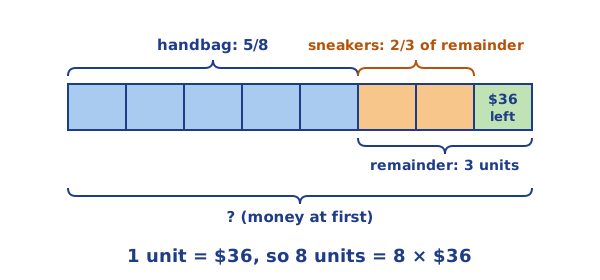
The 5/8 is a fraction of all Regina’s money. The 2/3 is a fraction of the remainder, the money left after the handbag. The $36 is what is left at the end. Her money at first is unknown.
Draw the model
Draw one bar for all her money and divide it into 8 equal units. Bracket 5 units as the handbag. The remainder is 3 units. Because the sneakers cost 2/3 of the remainder, split the remainder into 3 equal parts: each part is 1 unit. Bracket 2 units as the sneakers and label the last unit $36 left.
Work it out
- After the handbag, the remainder is 8 − 5 = 3 units.
- The sneakers cost 2/3 of the remainder, which is 2 units, so 1 unit is left.
- 1 unit = $36
- Her money at first was 8 units: 8 × $36 = $288
Answer
Regina had $288 at first.
Check
Handbag: 5/8 of $288 = $180, leaving $108. Sneakers: 2/3 of $108 = $72, leaving $108 − $72 = $36.
A helpful prompt
“Is the 2/3 a fraction of all her money, or of what was left after the handbag?”
Explore the Primary 5 programme.
Primary 6 (Grade 6) Word Problem Example
Example title: Working backwards on a school bus
Topic: Fractions and percentage, working backwards
Learning objective: Undo a chain of changes from the end, and find a whole from a known percentage and a known fraction.
Problem
There were some students on a school bus. 1/5 of the students alighted at the first stop and 8 students boarded the bus. At the second stop, 40% of the students alighted and 6 students boarded the bus. As the bus left the second stop, there were 30 students on the bus. How many students were there on the school bus at first?
Question from Spartan Maths 6A.
Understand the problem
Only the final number, 30, is known, so work backwards from the end. At each stop, students alighted first and then others boarded. The 40% is a percentage of the students on the bus when it reached the second stop. The 1/5 is a fraction of the students on the bus at first, which is the unknown.
Draw the model
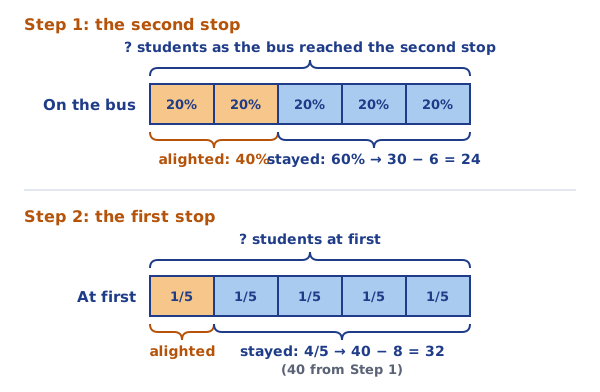
Draw two models, one for each stop, starting from the end. For the second stop, draw a bar for the students on the bus as it arrived, split into 5 equal parts of 20%: 2 parts alighted and 3 parts stayed. For the first stop, draw a bar for the students at first, split into 5 equal fifths: 1 fifth alighted and 4 fifths stayed.
Work it out
- Undo the 6 students who boarded at the second stop: 30 − 6 = 24. These are the students who stayed on.
- If 40% alighted, 60% stayed, so 60% → 24.
- 20% → 24 ÷ 3 = 8, so 100% → 8 × 5 = 40. There were 40 students on the bus as it reached the second stop.
- Undo the 8 students who boarded at the first stop, using the 40 from step 3: 40 − 8 = 32. These are the students who stayed on.
- If 1/5 alighted, 4/5 stayed, so 4/5 → 32.
- 1/5 → 32 ÷ 4 = 8, so 5/5 → 8 × 5 = 40.
Answer
There were 40 students on the school bus at first.
Check
Work forwards. 40 students; 1/5 of 40 = 8 alight, leaving 32; 8 board, making 40. At the second stop, 40% of 40 = 16 alight, leaving 24; 6 board, making 30.
A helpful prompt
“What was happening just before the bus left the second stop?”
Explore the Primary 6 programme.
Keep Practising
Choose the example at your child’s level, cover the working and try it together, then compare methods. For more questions at each level, with full answers, download our free worksheets.