
This guide shows how to use the bar model to solve word problems, step by step. You may also hear it called model drawing or the model method. Drawing bars helps a child sort out what they know and what they need to find, and see how the quantities relate before choosing a calculation. The model supports reasoning; it does not replace reading and understanding the problem. The worked examples run from Primary 2 (Grade 2) to Primary 6 (Grade 6), and our separate guide provides word problem examples by level.
What a Bar Model Is
A bar model is a simple drawing of a word problem, and part of the wider Singapore Maths method.
- Bars stand for quantities. A longer bar means a larger amount.
- Units are equal-sized boxes inside a bar. Equal boxes stand for equal amounts.
- Brackets show what a number refers to: one part, a total or a difference.
- Labels say who or what each bar represents.
- A question mark shows the unknown, the amount we need to find.
A known quantity has a number written on the model. The unknown has a question mark. Once both are on the page, a child can see whether they are looking for a total, a part or a difference, and that points to the operation.
There are two basic types. In a part-whole model, one bar is split into parts that make up a whole. In a comparison model, two or more bars sit one above the other so their lengths can be compared.
A simple process to follow:
- Read the whole problem, then retell it in your own words.
- Draw the bars: one bar for a whole, or one bar for each person or thing.
- Reread the problem one sentence at a time, writing each known number on the model.
- Mark the unknown with a question mark.
- Use the model to choose the calculation, then work it out.
- Write the answer as a sentence with units, and check it against the problem.
A model is most useful when a problem has several pieces of information, when wording such as “more than” could mislead, or when it involves fractions or ratio. A child who can see a simple one-step question clearly, such as 5 apples and 3 more, can solve it mentally.
Part-Whole Models
In a part-whole model, the parts join to make the whole. If all the parts are known, add them to find the whole. If the whole and all the other parts are known, subtract to find the missing part.
Example: Balloons sold over three days
Level: Primary 2 (Grade 2)
Topic: Addition, part-whole model with three parts
Problem: A shop sold 134 balloons on Friday, 158 balloons on Saturday and 96 balloons on Sunday. How many balloons did the shop sell over the three days?
Understand the problem: The three days are the parts, and all three are known. The total for the three days is the whole, and it is unknown.
Draw the model: Draw one long bar for all the balloons. Split it into three parts, with Saturday’s part the longest and Sunday’s the shortest. Label each part with its day and number, then put a bracket over the whole bar with a question mark.
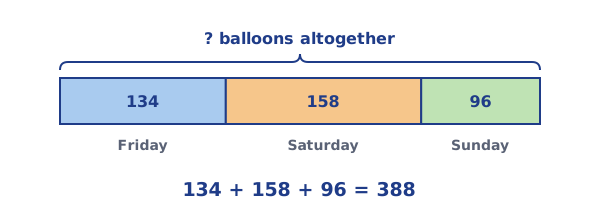
Work it out:
- The parts are known and the whole is missing, so add the parts.
- 134 + 158 = 292
- 292 + 96 = 388
Answer: The shop sold 388 balloons over the three days.
Check: Take the parts away again: 388 − 96 = 292 and 292 − 158 = 134, which is Friday’s number.
Teaching note: Some children draw three separate bars. Ask: “Are we finding all the balloons together, or comparing the days?”
Comparison Models
A comparison model shows two quantities, one bar above the other. Start both bars at the same line. Where the shorter bar ends, draw a dashed line down from the longer bar: the piece left over is the difference. Unlike a part-whole model, the bars are not pieces of one whole; they are two separate amounts.
Example: Cans collected for recycling
Level: Primary 3 (Grade 3)
Topic: Subtraction, one-step comparison model
Problem: A school collected 2450 cans for recycling this month. This is 680 more cans than it collected last month. How many cans did the school collect last month?
Understand the problem: This month’s total is known: 2450 cans. This month is greater than last month by 680 cans. Last month’s total is unknown.
Draw the model: Draw two bars that start at the same line. This month’s bar is longer and labelled 2450 cans. Last month’s bar is shorter and marked with a question mark. Mark the extra piece of this month’s bar as 680 more.
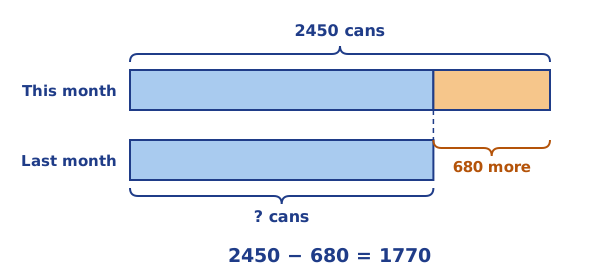
Work it out:
- This month’s bar is last month’s amount plus an extra 680.
- Take away the extra piece: 2450 − 680 = 1770
Answer: The school collected 1770 cans last month.
Check: 1770 + 680 = 2450, which is this month’s total, and last month is the smaller amount, as the problem says.
Teaching note: The word “more” often leads a child to add: 2450 + 680 = 3130. That would make last month the larger amount, which is not what the problem says. Ask: “Which month collected more? So which bar should be longer?”
Bar Models for Fractions and Ratio
Fractions
For a fraction problem, the bar is the whole. The denominator tells you how many equal units to draw, and the numerator tells you how many of those units you are talking about.
Example: Using part of a set of beads
Level: Primary 4 (Grade 4)
Topic: Fraction of a set
Problem: Aisha had 96 beads. She used 3/8 of them to make a bracelet. How many beads did she have left?
Understand the problem: The whole is all of Aisha’s beads, 96 beads. She used 3 eighths of them, so 5 eighths are left. The number of beads left is unknown.
Draw the model: Draw one bar for the 96 beads and divide it into 8 equal units, because the denominator is 8. Colour 3 units and label them used. Bracket the other 5 units and mark them with a question mark.
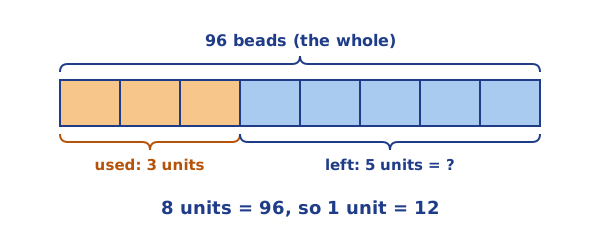
Work it out:
- 8 units = 96
- 1 unit = 96 ÷ 8 = 12
- Beads left = 5 units = 5 × 12 = 60
Answer: Aisha had 60 beads left.
Check: She used 3 units, 3 × 12 = 36 beads, and 36 + 60 = 96. Also, 5 eighths is more than half, and 60 is more than half of 96.
Teaching note: Some children work out 3/8 of 96, get 36 and stop. Ask: “Does the question ask how many beads she used, or how many she has left?”
Ratio
In a ratio model, every unit in every bar is the same size. Draw the bars in the same order as the ratio, so the first number belongs to the first bar. Then decide whether the number given in the problem is a part, a total or a difference.
Example: Comparing marbles with a ratio
Level: Primary 6 (Grade 6)
Topic: Ratio, finding a total from a difference
Problem: The ratio of the number of Ben’s marbles to the number of Chloe’s marbles is 3 : 5. Chloe has 28 more marbles than Ben. How many marbles do they have altogether?
Understand the problem: Ben comes first in the ratio with 3 units, and Chloe second with 5 units. The 28 marbles are the difference between them, not a part or a total. The total is unknown.
Draw the model: Draw Ben’s bar with 3 equal units and Chloe’s bar with 5 units of the same size, starting at the same line. Bracket Chloe’s 2 extra units as 28 more. Put a bracket beside both bars with a question mark for the total.
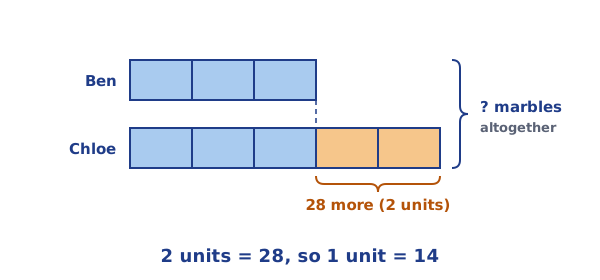
Work it out:
- The difference is 5 units − 3 units = 2 units, so 2 units = 28.
- 1 unit = 28 ÷ 2 = 14
- Altogether there are 3 + 5 = 8 units, so 8 units = 8 × 14 = 112.
Answer: They have 112 marbles altogether.
Check: Ben has 3 × 14 = 42 marbles and Chloe has 5 × 14 = 70. 70 − 42 = 28, and 42 : 70 simplifies to 3 : 5.
Teaching note: A common mistake is to treat 28 as Chloe’s 5 units. Ask: “Is 28 how many marbles Chloe has, or how many more she has?”
Example: Before and after, when the total stays the same
This harder example shows a multi-step technique: drawing the model twice, before and after a change.
Level: Primary 6 (Grade 6)
Topic: Ratio, before and after with an unchanged total
Problem: The ratio of the number of Jia Hui’s stickers to the number of Kumar’s stickers was 4 : 1. After Jia Hui gave Kumar 30 stickers, they each had the same number of stickers. How many stickers did Jia Hui have at first?
Understand the problem: Stickers only move from Jia Hui to Kumar, so the total does not change. Before, the ratio is 4 : 1. After, it is 1 : 1. Jia Hui’s number at first is unknown.
Draw the model: Use the same total number of units before and after. The 4 : 1 ratio has 5 units. To keep a whole number of equal units in each bar after sharing, write it as 8 : 2, a total of 10 units. After the change, 10 units split equally into 5 : 5. Draw both stages with units of the same size, and mark the 3 units Jia Hui gives away.
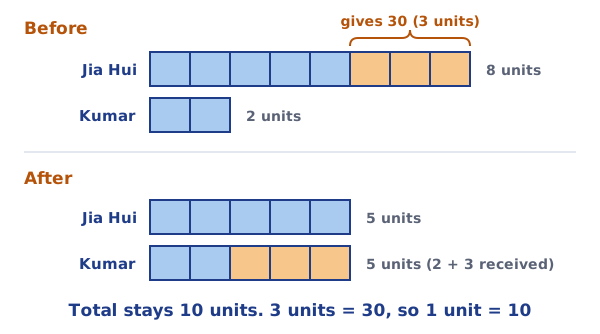
Work it out:
- Before: 4 : 1 = 8 : 2. After: 1 : 1 = 5 : 5. Both have a total of 10 units.
- Jia Hui goes from 8 units to 5 units, so she gives 3 units. 3 units = 30
- 1 unit = 30 ÷ 3 = 10
- Jia Hui at first = 8 units = 8 × 10 = 80
Answer: Jia Hui had 80 stickers at first.
Check: At first, Jia Hui had 80 and Kumar had 20, and 80 : 20 = 4 : 1. After the change, each has 50.
Teaching note: Children often ask why 4 : 1 becomes 8 : 2. Ask: “What stays the same?” (The total.) “How is it shared at the end?” (Equally.) So both models need the same number of units, and that number must split into two equal groups: 5 units cannot split into two equal groups of whole units, but 10 units can.
How to Teach It at Home
- Start with the story. Ask your child to retell the problem in their own words before drawing anything.
- Find the known and the unknown. Ask: “What do we know? What are we trying to find?”
- Let your child draw. The model does not need to be neat, but equal units should look roughly equal and every bar needs a label.
- Ask, rather than tell. Try: “Which bar should be longer?”, “Does this bracket show a part, the total or the difference?” and “Is the missing number a part or the whole?”
- Step back when stuck. Use objects or smaller, friendlier numbers to act out the story, then return to the drawing.
- Check against the story. Read the problem again with the answer in place, and write the answer as a full sentence with units.
Our free worksheets provide practice and answers for each level, from number bonds in Primary 1 to word problems in later levels.
Frequently Asked Questions
When should a child start using bar models?
Bar models build on the hands-on and picture work of the early primary years. Children usually start with simple part-whole and comparison drawings for addition and subtraction stories, then use units for multiplication, fractions and ratio in later years. Follow your child's school programme for the timing.
Does every word problem need a model?
No. A model is a tool for seeing how the quantities in a problem relate. If your child can explain a simple question clearly, they can solve it mentally. Multi-step problems and those with fractions or ratio are where drawing helps most.
What if my child's school uses another method?
Use the method your child knows, and treat the bar model as a way to picture the problem. Asking your child to explain the drawing or the calculation is more useful than insisting on one method.
My child draws the model but cannot choose a calculation. What should I do?
Point to the question mark and ask what it covers. If it covers the whole and every part is known, add the parts, or multiply if the parts are equal. If it covers one part and the whole is known, take away the known parts, or divide if the parts are equal. In a comparison model, the longer bar is the shorter bar plus the difference. If the model uses units, find the value of 1 unit first, then multiply by the number of units you need.